ShadowOS
AI-Powered Operational Intelligence & Workflow Simulation Platform 🕶️⚙️📊
ShadowOS is an enterprise-grade operational intelligence platform designed by Originyx. Built as a non-intrusive diagnostic layer, it connects to existing corporate data streams, system logs, and communication archives to map out the 'shadow operations' of an organization. By analyzing hidden inefficiencies, estimating manual task costs, and generating future-state workflow simulations, ShadowOS provides leadership teams with a clear, data-driven blueprint for automation before any code is written.
The Problem: Hidden Operational Friction
Modern organizations are drowning in process complexity. While teams use modern SaaS platforms (like CRMs, accounting portals, and ticketing tools), a significant amount of day-to-day operations occurs in 'shadow workflows'—namely local spreadsheets, manual email copy-pasting, chat threads, and unrecorded personal checklists. This creates massive fragmentation where leadership has zero visibility into how work is actually executed.
This lack of process clarity leads to two major issues: first, companies experience silent revenue leakage due to process delays, double-handling of customer records, and unresolved bottlenecks. Second, when companies try to solve these problems by automating workflows, they often target the wrong processes. Without diagnostic data, automation initiatives fail because they build on top of broken, unoptimized workflows, leading to wasted engineering capital and poor user adoption.
Traditional process auditing is also slow and inefficient. Companies hire external management consultants who conduct manual surveys and time-motion studies. These evaluations are highly subjective, take months to compile, cost tens of thousands of dollars, and provide static snapshots that quickly decay as business needs evolve.
Our Solution: Continuous Operational Intelligence
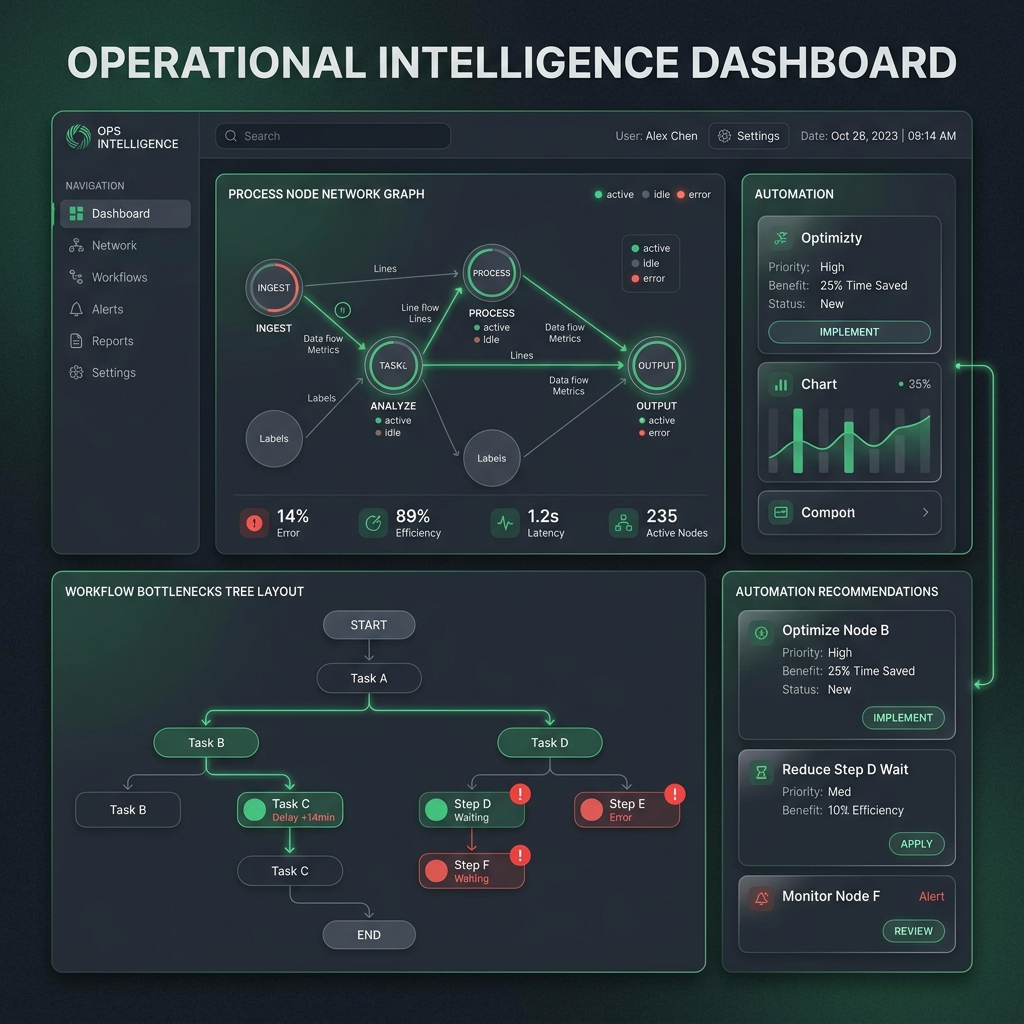
ShadowOS introduces a modern, AI-first approach to process mapping and workflow optimization. Instead of automating first, ShadowOS acts as an observation and diagnostic layer that answers a fundamental question: "How does the organization actually operate?" By ingesting raw system logs, API responses, and database histories, ShadowOS automatically maps real-world workflows in real-time, highlighting exactly where friction, waste, and bottlenecks occur.
ShadowOS empowers operational leaders to:
- Automatically reconstruct business processes from actual database event records.
- Identify double-handling, repetitive data transfers, and redundant manual tasks.
- Pinpoint the exact team members, roles, or software tools causing delays.
- Simulate workflow changes (Current State vs. Optimized State) before implementation.
- Compute the precise financial waste of operational inefficiencies using cost models.
- Build clean, clear transition blueprints for software developers and automation engineers.
Architecture & Process Extraction Pipeline
ShadowOS uses a secure, non-intrusive five-stage pipeline to convert unstructured activity trails into structured operational intelligence. This ensures complete data integrity, compliance, and precision at every step:
- Unified Event Ingestion Node: Connects securely to database change data capture (CDC) systems, CRM activity tables, and application event logs. It normalizes fragmented fields into a standardized schema (Timestamp, Case ID, Activity, Actor, System) using robust Pydantic schemas.
- Graph-Based Dependency Miner: Constructs hierarchical directed graphs mapping process pathways. It detects the true sequence of activities, looping behaviors (re-work), parallel execution paths, and dependencies across disconnected business units.
- AI-Powered Friction Analyzer: Leverages advanced reasoning models to evaluate the reconstructed process maps. It flags operational waste, excessive handoff times, compliance risks, and instances where employees bypass standard system procedures.
- Financial Cost & ROI Simulator: Combines process telemetry with labor cost models to calculate the dollar-value waste of bottlenecks. It runs 'what-if' simulations, projecting how automation or process re-engineering will improve throughput, reduce error rates, and save costs.
- Executive Intelligence Generator: Synthesizes complex graph analytics into natural language executive reports. It scores automation opportunities based on ease of implementation, ROI impact, and organizational risk, providing a prioritized development roadmap.
By separating the diagnostic phase from the execution phase, ShadowOS eliminates project risk, ensuring that software development resources are focused exclusively on high-value, high-ROI workflow automations.
Core Platform Features
Automated Process Mining
Reconstructs real-world processes from digital footprints, exposing how work is done without relying on interviews.
Waste Quantification
Translates process delays and manual efforts into actual cost metrics, demonstrating the exact value of optimization.
Workflow Simulations
Models 'what-if' automation scenarios to project efficiency increases, cycle-time reductions, and ROI before writing code.
Automation Roadmaps
Generates clear, structured technical specifications and priority scores for development teams, reducing engineering risk.
Strategic Value & Market Positioning
Traditional workflow optimization is slow and reactive. ShadowOS repositions how modern teams approach business transformation by introducing a continuous, data-driven intelligence cycle:
Relies on manual logs, employee interviews, and guesswork. Results are slow, static, and often ignore complex system edges.
Leverages non-intrusive event logs and AI reasoning to map workflows continuously. Results are objective, instant, and dynamic.
Automates processes blindly without checking if the underlying layout is optimal, which simply speeds up inefficiency.
First simulates workflow optimizations, eliminates structural friction, and then recommends automation for clean processes.
Measurable Business Impact
By integrating ShadowOS into core business units, leadership transitions from administrative oversight to strategic optimization, realizing significant improvements:
65%
Cycle Time ReductionOperational workflows are simplified, eliminating redundant steps and manual queues.
$120K+
Labor Cost SavingsHigh-volume repetitive data entries are mapped and prepared for automated agents.
4.5x
Automation ROI BoostEnsures development budgets are allocated only to high-impact opportunities.
100%
Workflow VisibilityLeadership gains continuous, audit-ready maps of actual operational behaviors.
Target Sectors & Integration Environments
ShadowOS is highly flexible and integrates seamlessly with various operational environments, including:
Real Estate & PropTech
Optimizes lease processing, tenant onboarding, maintenance dispatch loops, and transaction handoffs.
Professional Services
Maps client onboarding stages, compliance checks, invoice reconciliation, and reporting pipelines.
Operations & Support
Identifies support ticket escalations, multi-system lookup inefficiencies, and SLA bottleneck locations.
Frequently Asked Questions
What makes ShadowOS different from traditional business intelligence (BI) tools?
Traditional BI platforms query static databases to display outcomes (like sales totals or ticket volume). ShadowOS tracks process behaviors. It maps the paths, sequence, timing, and transitions of actions across multiple systems to reconstruct how the work occurred, rather than just showing the output.
Does implementing ShadowOS require installing tracking software on employee computers?
No. ShadowOS does not use invasive screen recording or keystroke logging. Instead, it relies on system-level event logs, API logs, and database change history to map activity paths. This ensures a privacy-first, non-intrusive environment for your workforce.
How long does the ingestion and process extraction phase take?
Initial workflow visualization and process graph models are generated within 48 to 72 hours of data connector integration. Comprehensive waste calculations, ROI simulations, and prioritization maps are typically delivered in two weeks.
How does the simulator predict ROI and process performance?
The simulation engine runs mathematical queue modeling and pathway branching. By modifying variable parameters (such as introducing automated agents at specific nodes), it projects downstream impacts, cycle-time reductions, and resource reallocation opportunities.
Can ShadowOS integrate with our existing software stack?
Yes. ShadowOS uses secure REST APIs and webhooks to integrate with common corporate systems (like Salesforce, HubSpot, Jira, databases, Slack, and spreadsheets). Our Pydantic-powered pipeline normalizes this data into a clean, unified event format without disrupting existing operations.