LifeOS
Your Life. One System. 🧠✨
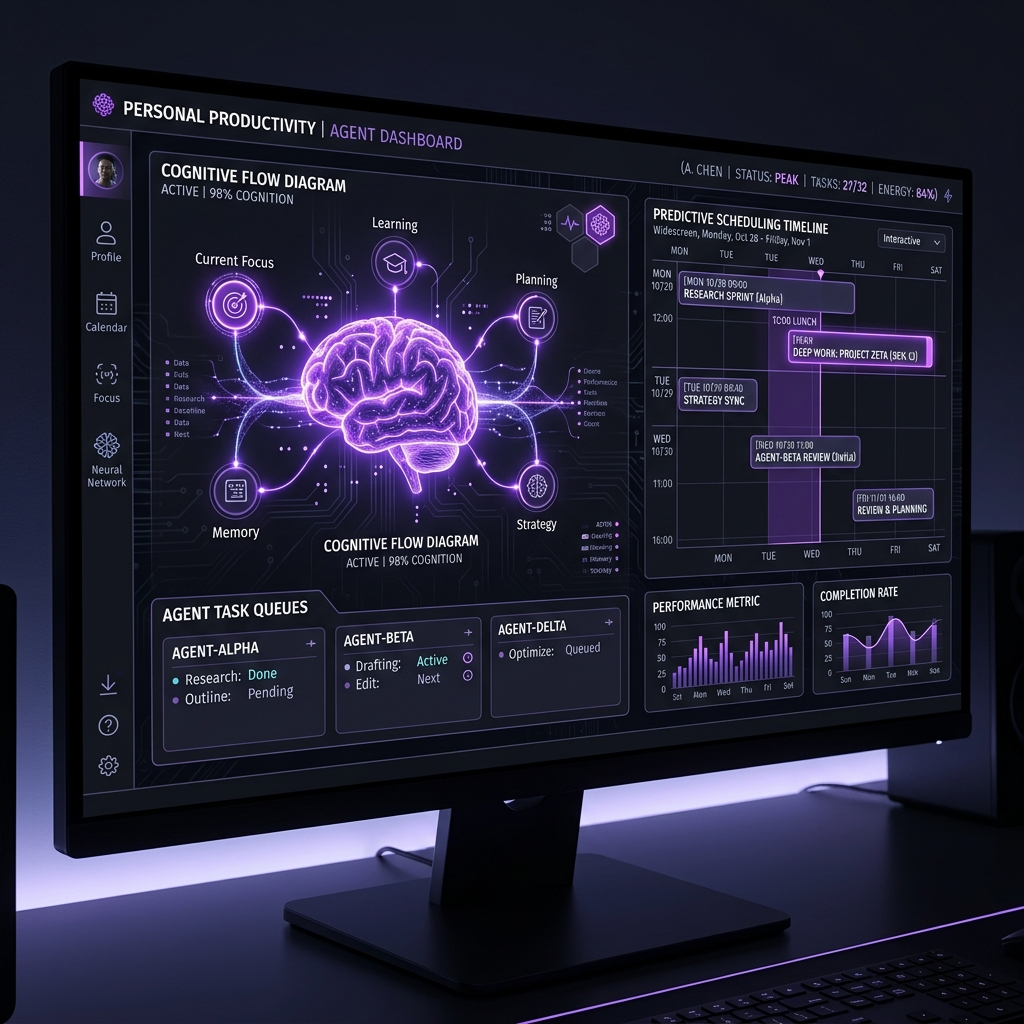
LifeOS by Originyx is an autonomous personal operating system and cognitive companion designed to serve as a unified command center. It integrates local-first databases, vector memory layers, semantic knowledge graphs, and agentic workflows to centralize your task management, personal knowledge, calendars, habit metrics, and strategic planning into one intelligent environment. By shifting administrative overhead to background agents, LifeOS frees up mental bandwidth, allowing you to operate at your peak cognitive capacity. Rather than forcing you to adjust to pre-configured templates, LifeOS adapts to your unique workflow, ingesting voice memos, daily notes, and calendar events into a single private space.
The Problem
Modern professionals are drowning in an ocean of fragmented applications. We manage tasks in one app, document ideas in another, coordinate calendars in a third, and outline goals inside isolated files. This digital noise leads to cognitive overload, tab fatigue, and lost information. The average user spends more time maintaining and syncing their productivity stack than actually executing their goals. Furthermore, traditional software remains passive; it stores text and numbers but fails to understand semantic relationships between daily logs and long-term career plans. When tools do not communicate, context is lost, and decision-making becomes reactive. This lack of centralized intelligence represents a major bottleneck for high performers seeking to optimize their focus.
Our Solution
Originyx designed LifeOS to serve as a proactive digital companion that shifts the paradigm from passive data logging to autonomous intelligence. LifeOS operates as a central brain that sits on top of your digital environment. By integrating local-first data stores with advanced Large Language Model reasoning, the system continuously monitors your inputs, constructs a private semantic memory, and identifies actionable paths toward your objectives.
Unlike traditional productivity applications that manage isolated tasks, LifeOS is designed to manage the entire operating environment around a user. The platform combines AI agents, memory systems, automation workflows, knowledge graphs, planning tools, and personalized intelligence into a single ecosystem. Users can manage projects, track habits, store knowledge, receive AI-driven recommendations, and maintain a clear overview of their personal and professional life from one interface.
What Makes LifeOS Different?
LifeOS shifts the paradigm of personal tooling from reactive records to proactive intelligence:
Core System Components
Intelligence Hub
Continuously ingests context, structures personal memories, and operates as your private intelligence database.
Agentic Scouts
Autonomous background AI agents that proactively simulate scenarios, monitor targets, and execute scripts.
Dynamic Knowledge Graph
Connects notes, active goals, contacts, and memories semantically to reflect real-world relationships.
Action Engine
Runs automated triggers, coordinates complex calendars, and optimizes habits based on cognitive load.
Habit & Energy Tracker
Correlates daily subjective energy ratings and habit completion rates to discover your optimal working hours.
Strategic Goal Planner
Translates long-term visions into monthly milestones, weekly goals, and daily tasks.
Visionary Scopes
Vision
LifeOS aims to become the personal operating system for the AI era, where every individual has access to an intelligent companion capable of managing knowledge, coordinating tasks, supporting decisions, automating routine work, and helping them operate at their highest potential.
"Your Life. One System."LifeOS Tagline
Frequently Asked Questions
What is LifeOS?
LifeOS is an AI-powered personal operating system that acts as a unified command center for decision-making, productivity, and growth. It unifies tasks, planning, memory, and knowledge graph mapping.
How do Agentic Scouts work?
Agentic Scouts are autonomous background AI processes that actively monitor your goals, simulate hypothetical future scenarios, analyze cognitive load, and execute background scripts without manual triggers.
Is LifeOS a local-first system?
Yes, LifeOS prioritizes user privacy. It stores knowledge, tasks, and memory graphs locally while utilizing encrypted cloud synchronizations and secure local vector search to keep personal data under your control.
Can I integrate LifeOS with existing tools?
Yes. The LifeOS Action Engine contains custom connectors and synchronization scripts that interface directly with standard APIs like Google Calendar, Notion, and Obsidian to aggregate all data into a single knowledge graph.