Enterprise RAG
Secure Knowledge Retrieval, Multi-Tenant Isolation & Cost Governance 🔒🏢
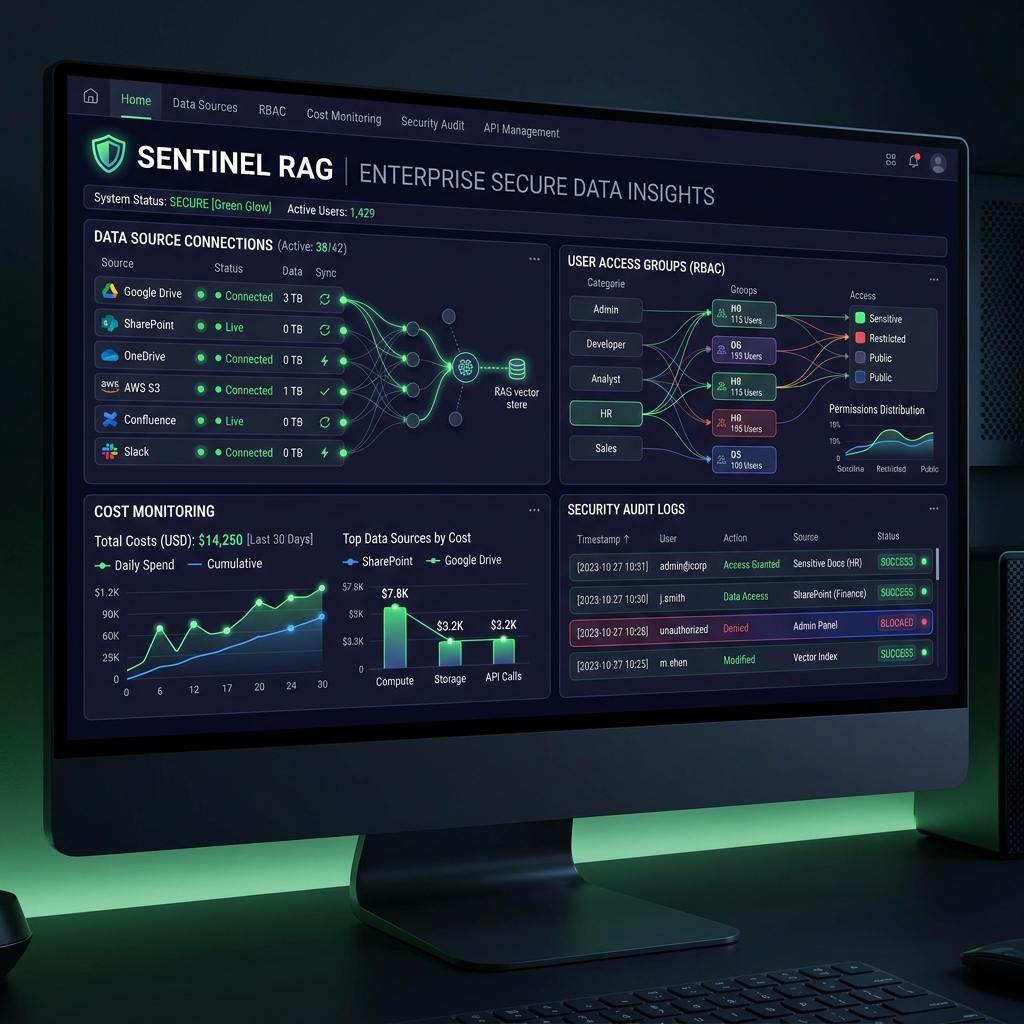
Enterprise RAG by Originyx is the gold-standard secure AI knowledge retrieval engine designed for modern corporate data architectures. It enables organizations to query internal files safely without exposing sensitive data, violating industry compliance regulations, or incurring runaway API costs.
The Enterprise Challenge
Enterprise knowledge is highly fragmented and unstructured. Over 80% of corporate data exists in disconnected formats such as PDFs, Word files, spreadsheets, emails, and internal wikis. Traditional search engines fail because they rely on exact keyword matches, completely missing synonyms, context, and the semantic relationships between distinct data points. This forces knowledge workers to spend up to 20% of their day digging through folders, stalling productivity and delaying decision-making cycles.
With the rise of consumer AI platforms, employees frequently copy and paste proprietary materials into public Large Language Models (LLMs) to summarize documents or generate reports. This practice represents a massive compliance hazard, violating strict data sovereignty laws such as GDPR, SOC 2, HIPAA, and CCPA. Once data enters a public model's API without enterprise-grade security wrappers, it risks being ingested, stored, or used as training data, leading to severe corporate liability and intellectual property leaks.
Finally, basic RAG architectures treat all ingested files as a single flat pool. If a junior engineer queries a flat RAG chatbot, they could easily retrieve executive compensation spreadsheets, board minutes, or product design blueprints simply because the search vectors are semantically similar. Deploying AI across an organization requires a system that respects existing active directories and user roles. Without fine-grained, row-level access control at the vector retrieval stage, enterprise-wide AI deployment is a liability.
The Enterprise RAG Solution
Enterprise RAG by Originyx represents the next generation of secure, compliance-ready enterprise AI. Built from the ground up to support high-scale deployments, it bridges the gap between raw generative intelligence and secure data governance. The system indexes internal databases and document stores, processes files through layout-aware pipelines, and hosts the content in a private cloud environment, ensuring complete data sovereignty. Your files are never used to train public LLM models, and your data never leaves your secure infrastructure.
Furthermore, Enterprise RAG integrates seamlessly with your existing Enterprise Identity Providers (IdPs) via OAuth2, SAML, and Keycloak, dynamically enforcing access control rules in real-time. Instead of simple chatbot interfaces, the platform serves as a secure knowledge broker that verifies clearance, partitions data by corporate tenant, logs query histories for security auditing, and maintains live dashboards to track API budgets and latency spikes. Originyx empowers your enterprise to scale AI productivity with confidence, performance, and predictability.
Key Core Capabilities:
- Zero-trust metadata-enforced document query paths
- Multi-tenant isolation protecting commercial databases
- Automated semantic caching to reduce token expenses
- Centralized token tracking and department budget caps
- Traceability metrics integrated with Langfuse and OpenTelemetry
Core Architecture & Ingestion Pipeline
An enterprise RAG system is only as good as its ingestion pipeline. The platform employs a multi-step sequence to clean, parse, embed, and secure incoming data:
During ingestion, raw files are stripped of formatting. Scanned documents run through layout-aware OCR (Optical Character Recognition) using engines like Tesseract or LayoutLM to extract text from images and tables in their logical reading order. Next, recursive semantic chunking segments text at natural heading and paragraph boundaries, maintaining slide-overlap windows to prevent text fragmentation.
Each segment is tagged with metadata fields including tenant_id, department, and clearance_level. These segments are processed by embedding models (such as OpenAI text-embedding-3) and written to the database. During querying, the user's roles are converted into metadata query filters. This dynamic check ensures that unauthorized vector rows are filtered out before cosine similarity calculations occur, blocking unauthorized data from ever entering the LLM prompt.
Role-Based Access Control (RBAC) & Multi-Tenant Isolation
Security is the primary differentiator between consumer-grade chatbots and enterprise-grade systems. Enterprise RAG implements a zero-trust model at the retrieval level. If a user tries to query documents above their clearance, the database blocks retrieval prior to generative processing.
❌ Standard Flat RAG
↓
Flat Vector Search
↓
Exposes all matching documents
↓
Risk: Data Leakage
✓ Enterprise RAG (RBAC)
↓
Metadata Security Filters
↓
Restricted Vector Search
↓
Retrieves authorized chunks only
In practice, when an employee submits a query, the FastAPI backend checks their session token via Keycloak or Auth0. If a junior engineer (Clearance Level 2) queries "Show executive financial reports" (Clearance Level 5), the system blocks access dynamically.
This filter is enforced at the database level. For example, using pgvector in PostgreSQL, the SQL query applies a strict metadata check in the `WHERE` clause:
WHERE tenant_id = :current_tenant
AND clearance_level <= :user_clearance
ORDER BY embedding <=> :query_embedding LIMIT 5;
This prevents cross-company data leakage and cross-department security violations, maintaining compliance and absolute data separation across teams.
Cost Monitoring, Caching, & Token Governance
Running production AI at scale can quickly become cost-prohibitive. Long context windows and frequent search loops lead to massive token consumption and high API bills. Enterprise RAG solves this through token governance tools and semantic optimizations.
The platform features a Redis-based Semantic Cache. When a query is submitted, the platform vectorizes the question and searches the local Redis cache. If a semantically similar query was answered recently, the cache serves the generated response directly. Semantic caching reduces API fees by up to 60%, slashes latency from seconds to milliseconds, and keeps operational costs under control.
Additionally, the platform logs metadata details for every request to track usage patterns:
Administrators can monitor cost structures across different departments and set monthly spend thresholds using the dashboard metrics panel:
Observability, Tracing, & LLM Guardrails
Production systems require deep monitoring. Enterprise RAG integrates Langfuse, OpenTelemetry, Prometheus, and Grafana to track queries from start to finish. This enables team members to audit retrieval quality, identify bottlenecks, and measure cosine similarity scores to prevent system decay.
The platform also implements real-time LLM Guardrails. Input guardrails check user inputs to detect prompt injection attempts, malicious scripts, and jailbreak attempts. Output guardrails scan generated responses before they are returned to users, verifying that no PII (Personally Identifiable Information), internal code, or unauthorized references are leaked. If a guardrail is triggered, the system intercepts the response, alerts administrators, and returns a safe fallback message.
Core Architecture Highlights
Granular RBAC Integration
Dynamic document-level security filtering integrated with active corporate IdPs to enforce data access levels at search time.
Multi-Tenant Architecture
Strict logical partition logic ensures different organizations or departments operate within separate secure database environments.
Performance Caching
Redis semantic caching serves repetitive queries locally, reducing API fees, protecting rate limits, and lowering latencies.
Observability Stack
Full tracing of LLM prompts and vector database query steps using Langfuse and Prometheus to monitor response quality.
Technical Specifications
Enterprise RAG features a modular, vendor-agnostic architecture. Every component—from the vector database to the frontend interface—can be customized or deployed in private VPC environments to meet compliance needs.
| Layer | Technology Specification |
|---|---|
| Frontend App | Next.js with custom CSS and dashboard layouts |
| Backend API | FastAPI running asynchronously on Python |
| Identity Provider | Keycloak / Auth0 / Clerk / SAML Integration |
| Worker Queue | Celery and Redis for ingestion and processing |
| Vector Database | pgvector on PostgreSQL / Pinecone Enterprise |
| Models Supported | OpenAI (GPT-4o), Anthropic (Claude 3.5), Llama 3 via vLLM |
| Observability | Langfuse tracing / OpenTelemetry integration |
| Metrics Collection | Prometheus and Grafana dashboard suites |
Frequently Asked Questions
How does Enterprise RAG guarantee data sovereignty?
Our platform is designed for private VPC deployments (AWS, GCP, Azure) or on-premise environments. Your data is stored locally within your secure infrastructure and is never sent to public models to train commercial LLMs.
How does the RBAC system sync with our existing identity providers?
Enterprise RAG connects directly with enterprise identity platforms via OAuth2 and SAML. When a user authenticates, their roles are translated into security tokens. These tokens are used by the backend to filter vector database queries in real-time.
Can the platform process scanned files and images?
Yes. The ingestion pipeline includes layout-aware OCR models (like LayoutLM) that parse text, tables, and images in scanned PDFs and forms, ensuring that document structure and context are preserved.
Does semantic caching respect document security boundaries?
Yes. Every item in the semantic cache is tagged with a permission hash. The cache will only serve a result if the current user's roles and tenant identifier match the permissions of the cached answer, maintaining strict access control.
"Enterprise RAG by Originyx bridges the gap between raw LLM capabilities and secure, cost-controlled business intelligence."Enterprise RAG with RBAC & Cost Monitoring